


Are you tired of relying on glasses or contact lenses to correct your vision? Trifocal lens technology offers a revolutionary solution, providing clear vision at multiple distances. This advanced intraocular lenses (IOLs) are designed to reduce or eliminate the need for corrective eyewear after cataract surgery or refractive lens exchange.
Unlike traditional monofocal lenses, trifocal lenses utilise innovative optical technology to split incoming light, allowing the brain to adapt and create a smooth transition between focal points. This results in improved visual independence and a better quality of life.
To determine if trifocal lens replacement surgery is right for you, a personal consultation is necessary. We encourage you to contact us for more detailed information and to discuss your options.
Key Takeaways
- Trifocal lenses provide clear vision at multiple distances, reducing the need for glasses.
- This advanced technology improves visual independence and quality of life.
- A personal consultation is required to determine suitability for the procedure.
- Trifocal lens replacement is a long-term investment in your vision health.
- It can eliminate ongoing costs associated with glasses and contact lenses.
Understanding Trifocal Lens Replacement
Trifocal lens replacement is a revolutionary solution for individuals seeking to improve their vision at multiple distances. Trifocal lenses are advanced intraocular implants designed to restore clear vision at near, intermediate, and far distances.
What Are Trifocal Lenses?
Trifocal lenses are specifically designed to provide clear vision at three distinct focal points: near, intermediate, and distance. This is achieved through diffractive technology that splits light into three points, allowing the brain to select the clearest image for each viewing distance.
How Trifocal Lenses Differ from Other Options
Unlike standard monofocal lenses that only correct vision at one distance, trifocal lenses offer a broader range of vision correction. They differ from multifocal lens options, which often lack the intermediate vision range. Trifocal lens replacement is particularly beneficial for modern lifestyles, enabling individuals to perform daily tasks like computer work, reading car dashboards, and using mobile devices with ease.
The Benefits of Trifocal Lens Replacement Surgery
Trifocal lens replacement surgery offers numerous benefits that can significantly improve one’s quality of life. By providing continuous, natural vision at all distances, trifocal lenses eliminate the need for glasses or contact lenses, making everyday activities more convenient.

Patients who undergo trifocal lens replacement surgery can enjoy a life free from the hassles of glasses and contact lenses. This freedom enhances their ability to engage in various activities without restrictions.
Freedom from Glasses and Contact Lenses
The primary benefit of trifocal lens replacement is the freedom from dependence on glasses and contact lenses for most daily activities. This means individuals can enjoy swimming, sports, and other physical activities without the limitations imposed by corrective eyewear.
Enhanced Vision at All Distances
Trifocal lenses provide seamless vision at all distances—near, intermediate, and far—without the need to switch between different pairs of glasses. This results in enhanced distance vision and clear vision for reading small print and using digital devices, significantly improving overall vision and quality of life.
How Trifocal Lenses Work
Understanding how trifocal lenses work is crucial for appreciating their value in vision correction. Trifocal lenses are designed to provide clear vision at multiple distances, addressing a key challenge in vision correction. We will explore the sophisticated optical design that enables this functionality.
The Three Focal Points Explained
Trifocal lenses use diffractive technology with a series of concentric rings to create three distinct focal points. The main portion of the lens corrects distance vision, while additional diffractive rings correct for near vision, and a smaller set of rings addresses intermediate vision. This design allows the lens to split incoming light into three focal points simultaneously, enabling the brain to select the clearest image based on what the person is looking at.
- The main portion of the lens works to correct distance vision.
- Additional diffractive rings correct for near vision.
- A smaller set of rings addresses intermediate vision, such as computer work.
Advanced Optical Technology
The technology behind trifocal lenses includes a special process that reduces stray light phenomena, minimising potential side effects like glare and halos. Aspherical optics provide optimised image quality and improved contrast vision in various lighting conditions. This advanced optical technology ensures that patients can enjoy clear vision across different distances and environments.
For more information on trifocal lens replacement and to discuss pricing, please contact us for the most up-to-date details.
The Trifocal Lens Replacement Procedure
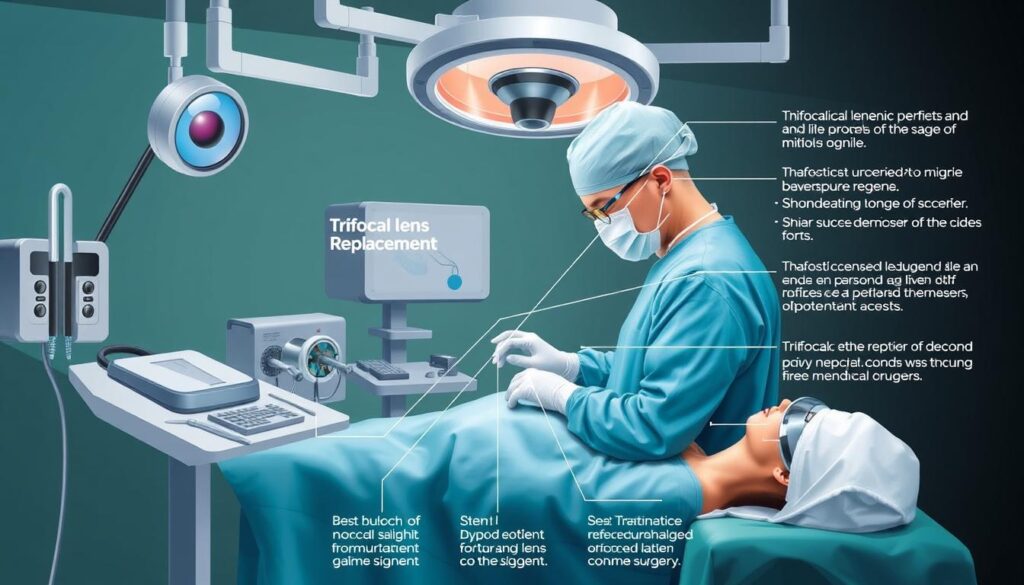
The trifocal lens replacement procedure involves a series of precise steps to ensure optimal results. Before undergoing surgery, a comprehensive pre-operative assessment is conducted, including detailed eye measurements and discussions about visual expectations.
Preparation Steps
To ensure accurate measurements, it is essential to stop wearing contact lenses before the pre-operative assessment – one week for soft lenses and two weeks for hard lenses. This step is crucial for selecting the most appropriate trifocal lens.
During the Procedure
The trifocal lens replacement surgery is a quick outpatient procedure that typically takes 15 minutes per eye. Performed under local anaesthetic eye drops, the surgery involves making a tiny self-healing incision in the cornea, removing the eye’s natural lens, and implanting the custom-selected trifocal lens using a specialised injector. The procedure is generally painless, with most patients experiencing only mild pressure sensations.
Recovery and Adaptation After Trifocal Lens Surgery
As you embark on the trifocal lens replacement journey, understanding the recovery and adaptation process is essential. The lens implantation surgery is a significant step towards improved vision.
Immediate Post-Surgery Experience
Most patients experience minimal discomfort after the surgery, with some feeling a slight sensation in the eye or mild irritation. This typically subsides quickly with prescribed anti-inflammatory and lubricating eye drops.
The Adaptation Process
The brain adapts to the new lens by learning to process different focal points. This adaptation process usually takes a few weeks, during which vision clarity improves.
Long-Term Results
After the adaptation period, patients can enjoy sustained clear vision at all distances, reducing their dependence on glasses for most daily activities and improving their quality of life.
Are You Suitable for Trifocal Lens Replacement?

If you’re considering trifocal lens replacement, understanding your suitability is crucial for a successful outcome. Trifocal lenses are designed to provide clear vision at multiple distances, addressing presbyopia and other vision issues.
Ideal Candidates
Trifocal lenses are ideal for individuals over 40 experiencing presbyopia, as well as those with cataracts or seeking refractive lens exchange. These lenses can correct multiple vision problems simultaneously, including short-sightedness, long-sightedness, and astigmatism with toric trifocal lenses.
Medical Considerations
However, certain medical conditions may affect suitability. For instance, patients with advanced glaucoma, macular degeneration, or diabetic retinopathy may not be ideal candidates. Additionally, those with high levels of astigmatism (1.75D and above) may require specialised toric trifocal lenses.
A comprehensive consultation and eye examination are essential to determine individual suitability. We assess the health of your eyes and discuss your lifestyle needs to ensure trifocal lenses are the right choice for you. For more information on pricing, please contact us to discuss your specific needs.
Trifocal Lenses vs. Alternative Vision Correction Options
When considering vision correction options, it’s essential to understand how trifocal lenses compare to other available choices. Trifocal lenses have emerged as a sophisticated solution for individuals seeking to address multiple vision problems simultaneously.
Comparison with Monofocal and Bifocal Lenses
Trifocal lenses differ significantly from monofocal lenses, which are commonly used in standard cataract surgery. While monofocal lenses provide excellent vision at a single distance, they often necessitate the use of reading glasses for near tasks. In contrast, trifocal lenses offer three focal points, enabling clear vision at near, intermediate, and far distances. Bifocal lenses, often mislabelled as multifocal lenses, provide vision at two distances but lack the intermediate focal point that trifocal lenses offer. This intermediate vision is crucial for everyday activities such as using a computer, viewing a car’s dashboard, or reading a recipe book.
By providing an additional focal point, trifocal lenses eliminate the “vision gaps” associated with bifocal lenses, ensuring a more seamless visual experience across various distances.
Advantages Over Glasses and Contact Lenses
Trifocal lenses also present several advantages over traditional glasses and contact lenses. Unlike glasses, trifocal lenses provide a wider field of vision and are not susceptible to fogging, scratches, or the need for constant cleaning. Moreover, they eliminate the risk of losing or breaking glasses. Compared to contact lenses, trifocal lenses remove the hassle of daily insertion and removal, reduce the risk of dry eye symptoms, and lower the risk of eye infections.
Furthermore, trifocal lenses offer a permanent solution to vision correction, unlike glasses and contact lenses, which represent ongoing expenses and maintenance. They can correct multiple vision issues simultaneously, including presbyopia, myopia, hyperopia, and astigmatism, reducing the need for multiple pairs of glasses for different distances.
For those interested in exploring trifocal lens replacement, we recommend contacting us for more detailed information on the procedure and associated costs.
Common Concerns About Trifocal Lens Replacement
As with any surgical procedure, trifocal lens replacement raises several questions and concerns among individuals considering it. Patients often wonder about the potential side effects, the longevity of the lenses, and how their eyes will adapt to the new trifocal lenses.
Addressing Night Vision and Halos
Some patients may experience mild halos or glare in the first few weeks, especially at night. However, these visual phenomena typically diminish as the brain adapts to the new visual system. Advanced diagnostics and surgical expertise help minimise these effects from the start.
Longevity of Trifocal Lenses
Trifocal lenses are designed to last a lifetime and do not degrade over time. Once implanted, you typically won’t need to worry about replacing them, giving you lasting clarity and peace of mind. This makes them a reliable choice for those undergoing cataract surgery or refractive lens exchange.
Adaptation Period Expectations
The adaptation process varies between individuals, but most patients adapt to their new vision within 2-4 weeks. The brain learns to process the three focal points and select the clearest image for each visual task, making the adaptation a neural phenomenon rather than a physical healing process.
For more information on how trifocal lens replacement can address your specific needs and concerns, we encourage you to contact us for personalised advice and to discuss pricing details.
Conclusion: Taking the Next Step Towards Clearer Vision
As we conclude our exploration of trifocal lens replacement, it’s clear that this advanced technology offers a life-changing solution for individuals seeking freedom from glasses and contact lenses. Trifocal lenses provide clear vision at all distances—near, intermediate, and far—making them an ideal choice for today’s active lifestyles.
We encourage you to take the next step by booking a consultation to determine your suitability for trifocal lens replacement surgery. A comprehensive eye examination is essential to assess individual needs and expectations, ensuring the best possible outcome. With a quick procedure that typically takes just 15 minutes per eye and a rapid return to normal activities, trifocal lens replacement is an attractive option for those looking to enhance their vision and simplify their life.
For more information about trifocal lens replacement, including details about the procedure, recovery, and pricing options, please contact us. Our experienced team is dedicated to providing personalised care throughout the entire process.
FAQ
What is the difference between multifocal and monofocal lenses?
Multifocal lenses, such as trifocal ones, are designed to provide vision at multiple distances, whereas monofocal lenses are set to focus at a single distance, requiring the use of glasses or contact lenses for other distances.
How long does the procedure take?
The lens exchange procedure typically takes around 15-30 minutes per eye, and is usually performed under local anaesthetic to minimise discomfort.
Will I still need to wear glasses after the surgery?
Many patients find that they no longer need to wear glasses for most daily activities after trifocal lens implantation, although some may still require them for certain tasks, such as reading or driving at night.
What are the potential risks and complications associated with trifocal lens implantation?
As with any surgery, there are potential risks, including infection, inflammation, and visual disturbances such as glare or halos. However, these are relatively rare and often temporary.
How long does it take to adapt to the new lenses?
The adaptation process typically takes a few weeks, during which time our brain adjusts to the new way of seeing. Most patients report a significant improvement in their vision within a month.
Can I undergo cataract surgery with trifocal lens implantation?
Yes, trifocal lenses can be used in cataract surgery to replace the cloudy natural lens and provide improved vision at multiple distances.
Are trifocal lenses suitable for people with astigmatism?
Yes, trifocal lenses can be used to correct astigmatism, although additional corrective measures may be necessary in some cases.
How do trifocal lenses compare to contact lenses?
Trifocal lenses offer a more permanent solution than contact lenses, eliminating the need for daily maintenance and reducing the risk of eye irritation.


